Thursday, December 31, 2009

Happy New Years from the Bar-barians!


We'd like to hear some of your goals and dreams for the coming year! 2010!! Post in the comments. One arms, new personal records, eat better or even just workout more often. What shall we look out for from you in 2010?!

The Technician Strikes Back - Trailer

Don't let people, circumstances or incidents in your life weigh you down. Push Through, Rise Above and Lift the Weight Up Off of You!

Friday, December 25, 2009

Top 10 Moves of 2009 (DOC's top picks)


2009 has been a very good year in terms of fitness accomplishments. So now we are at the end of the year and I'm sure everyone would love to see a video culminating all the hard work & memorable moments of 2009....So here it is. The top 10 moves of 09 presented by production teams for Evolution of Exercise Series, Barbarians, Strictly Bar talk to the whole "Get Familiar" extended family. Now not being on this list does NOT mean you don't put work in, this list reflects the people we were fortunate enough to catch up with & events we were around for. If you feel as though you can do better than something you saw, I invite all to challenge any move. You can have you clip replace any clip on this list. Log on to http://bar-barians.com/ for more details. Enough Talk.... You Gotta C This - DOC

Friday, December 18, 2009

Guinness World Records™ - most consecutive muscle-ups

Alright so we're sponsoring and supporting our Elite Bar-barian brother Jaz from the world famous Bondi Beach, AU in putting down the world record for muscle ups. He's going for 35, crushing his previous record of 25! Hell of a way to kick off the new year! We ask you to wish him the best! CLICK HERE

Tuesday, December 1, 2009

Wednesday, September 16, 2009

StrictlyBarTalk***ZEF-aka-Zakaveli***EXCLUSIVE INTERVIEW...Pt.1

StrictlyBarTalk interviews "ZEF" Co-Founder of THE BAR-BARIANS...(one of the top teams in the Bar-Movement).and a very laid back individual ...until he hits the Bar...to show and prove...why he is a..."BAR-BARIAN...actions are best received when words underline their reality..."My last rep..is like the first...if I can't get the last like the first...I won't try to do it"..(to quote)

Friday, September 11, 2009

Bar-barians on Facebook


-New Photos
-Old Never Before Seen Video Clips
-and the Latest Bar-barians News!

It's an open group so feel free to invite others, post on the discussion board, and write on the walls. Already 177 members and growing fast!

CLICK HERE to go to the group.

Wednesday, August 26, 2009

Rejoining a Gym

So i stopped working out at commercial gyms (except for free passes ;) ) in spring 2007. Since then I've been using scaffolds, pull-up bars, and my minimally equipped home gym. Now I'm probably going to rejoin a gym. I benefitted a lot from limited access to machines, it forced me to be creative. Now though there are a lot of reasons for me to go back to the gym. Here are a few of them:

-assisted pull-up machine: I really like using these for one-arm pulling / chinning practice

-wife is too prissy for outdoor workouts, hopefully she will be able to stick with a routine better with a gym membership (I'll let you know how this works out LOL)

-dumbell pressing: I have adjustible dumbells at home but they are cumbersome, and don't get very heavy. I like to do Arnold Presses, and various dumbell cross pulls. Obviously I'm too weak to do Inverted cross pulls on the rings, but I'm trying to work that motion with dumbells. I'll do the same for maltese to planche pulls.

-Heavier single leg deadlifts: most of the time I use my home barbell for these (which goes up to about 145) and I make them harder by increasing the torque and doing them straight leg style. Now I will also progress torwards heavier weights in a more conventional ROM. I'm still going to avoid very heavy deadlifting on two legs because I feel that it puts one at too much risk of back injury.

-Unfortunately this chain of gyms does NOT have a good place to do glute ham raises. One of my favorite exercises. Maybe I will be able to rig something up.

In the comments let me know how you guys take advantage of all of the equipment at your gyms. I'm always looking for new ideas.

Monday, August 24, 2009

Strictly Bar Talk

Phorm's Youtube Channel where you'll be hearing from many top players in the bar-movement. Plenty of interviews coming.

Beastmode


D300 speaking on the BIGUN competition

Saturday, August 22, 2009

Muscle Up Advice


We've received many emails that go something like this, "I think I'm strong enough to do muscle ups but I'm missing the technique!" Muscle ups can be achieved through momentum but immediately work towards cleaning up the form! The best thing for this type of strong individual, is full on explosive pull-ups. Forget about the chin. If you can pull yourself up to your chest or better yet the stomach, then technique/transition will not be an issue and you will make easy work out of muscle ups.

If you can already do muscle ups and are trying to correct your form, Hold a brick between your feet. The extra weight will keep your legs down and if you kick too much you'll drop the brick.

Just keep on pullin...

Despereately seeking

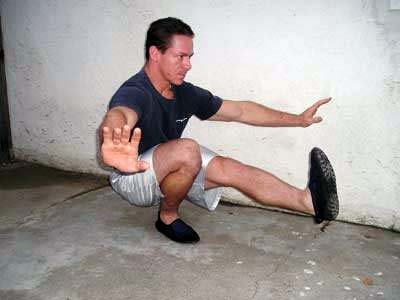
a video clip of a top quality one legged squat. What I mean by that is a pistol executed without momentum, forward lean, counterweight or back rounding to full depth. If you have such a link please post it in the comments. Also barefoot is preferred as heel elevation makes the movement significantly less challenging.

I would like to post the vids here so we can start establishing a standard for lower body bodyweight strength excellence.

Friday, August 21, 2009

Slow Muscle-ups -> Close to impossible

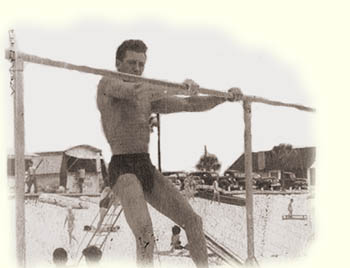
Here is a photo of legendary bodyweight strength specialist Jasper Benincasa performing what is called the Close To Impossible (CTI for short):


Supposedly this photo was not taken midswing or with Jasper standing on a block, it is a STATIC hold! Now let's put aside for a second whether or not this is true, instead lets take it as a goal (even if it is possibly unattainable). We can try to progress from a slow muscle-up on the bar torwards the CTI first by performing a slow bar muscle-up with a wider and wider grip until we are doing it with the arms almost straight and then once this becomes easy if ever we can start doing it with the arms straight and a narrower grip. Or we can try to progress from a victorian on the bar torwards this goal by gradually lowering the body whilst maintaining distance from the bar.

These progressions are too advanced to be attempted by most anyone I know anytime soon but they illustrate in a general sense another way that torque can be used to make any bodyweight exercise almost impossiblly difficult. For more on torque and bodyweight sttrength check these past posts: Generally, with regard to pistols

Thursday, August 20, 2009

Livewire and friends in NYC

These guys are nuts, it was very scary and exciting to watch them do their thing in TSP:


after the jump see more from their trip and some of the Barbairians with a dedication to P


Unreal Power


see if you can figure out the "secret" to Yuri's strength here.

True Ninja Warrior

watch UnlimitedClifferno4 demolish the Sasuke replica course:


This guy is very strong:


if you watch his other videos you will see that he also does some specific training for the obstacle course especially the cliffhanger and salmon ladder.

The Technician '09 - "The Manual" - Official Trailer

Bar-barians on Fitness Black Book


Fitness Black Book is a site that knows the real deal on fitness. They really did their research on us and wrote up an awesome article! Thank you for taking your time to do this. We very much appreciate it. This inspires us to work harder and harder and take it to the next level! Article below:

FITNESS BLACK BOOK

Sunday, August 16, 2009

Competition Updates

Zakaveli showed up on Zef-time late.

Tech and Hit tied for first place.

B-Rock threw down hard and should be up there as well!

Tuesday, August 11, 2009

Summer Tournaments

B-Xtreme comp was held over the weekend on Sun. The Technician took home first place for the Bar-Commission.

Next week is the BigUn tournament. Rumors been spreading that Zakaveli might enter and that all hell could break loose on the bar!!

We'll keep you posted!

Friday, August 7, 2009

Beast and Zef - Weighted Muscle Ups

Don't let people, circumstances or incidents in your life weigh you down. Push Through, Rise Above and Lift the Weight Up Off of You!


Special Thanks to:

-Beast for coming through
-Zakaveli for the video concept
-Metin Dabak for making the beats
-Rick Seedman for filming, directing and editing
-and DOC for helping film

Tuesday, August 4, 2009

Advanced Ring Elements


Thanks to Coach Sommer at gymnasticbodies.com for this one. Some incredible strength elements here.

Sunday, August 2, 2009


now this is a true push-up at 7 seconds in. Anything less is girlie style....more posts to come from mad money.


Type rest of the post here

Monday, July 6, 2009

First Annual Bar-Commission Bar-B-Q weekend

was a success! So many people came out and we thank each and everyone of you for making this weekend so special!

It was a beautiful event. Zef, Jude, Rick and Sheriff arrived at 430am Saturday morning, on no sleep, to hold down the tables and didn't leave until 10pm. The next day we hit up TSP. Zef got the FULL PLANCHE HOLD! and then went over to Wingate to finish off the day. Long weekend full of no sleep, plenty of food, tons-o-fun and a whole lot of working out.

This vid is a thank you to all who were there, in person and in spirit.


Special thanks to Andy, Zef, Ana, Jude, Rick, Sheriff, Keith, Anthony, Jeffery, Rob, The Tech family, The Phorm family, The Lois family, The Grevenitis family, Redd, Allison, B-Rock, DOC and many more...

Tuesday, June 30, 2009

First Day of Summer '09

Its been raining in New York for the past month, so the first day of summer wasn't to hot. We made the best of it though. Played in the rain like a bunch of kids. Good sessions!

Hanging out at the dip bar with Guils from France, Anthony aka Nirose9, Zef, Jude and Rick of Bar-barians and Wingate's finest, Brian + the mayor of Wingate, DOC.


a little thank you video from Zakaveli

Friday, June 26, 2009

Bar-barians '09 - Jude

This is the long overdue video of Bar-barians co-founder, Jude. He is an incredible individual and a huge part of our bar-family.


Approved by the Bar-Commission

Sunday, June 21, 2009

Highland Park

Highland Park's Morning Session and some freestyle. Special thanks to Mr. and Mrs. Harrision, Guils, Rick and the Highland Park crew.


Friday, June 19, 2009

Fan made video

for the one and only Zakaveli. Beat and video made by Metin.


Endless thanks to Metin.

Bar-barians '09

Some action footage from the documentary. Most of the footage was from the May, 25 2009 session at TSP. The rest was from Feb at Wingate. Biggie is 16 years of age. He's Zef's nephew. He came through to show Zef his OAP that he recently attained.


Approved by the Bar-Commission

Thursday, June 11, 2009

Wednesday, May 27, 2009

Advice


We have been receiving many email about how to get started.

It always starts with the basics. Straight reps- pull/chin ups, dips etc. If you're just starting, practice every second day as the rest day really seems to help. Once you feel well conditioned, get creative, start freestyling and then you will be able to just go off of what your body tells you.

Thursday, May 14, 2009

Monday, May 11, 2009

Marines Push Ups

We've posted bodyweight training from a variety of sports and disciplines such as parkour, b-boying, rock climbing, martial arts, gymnastics, body building, park workouts etc. We'll lets not forget about the military! There training consists of mostly bodyweight exercises. In the video the Marines demonstrate what is called a Four Count Push Up.

Wednesday, May 6, 2009

Links

Links to the Bar-Commission's sites:

HarmlemSEALS have been doing a lot of community work lately. Check out their site here

Calisthenics Kingz has some new info on their site with their newest member Kylie. You can check it out here

Saturday, April 18, 2009

Bar-barians Circuit

People have been requesting a routine to follow, so here you go.

Its a circuit. 3 rounds. Each round should be completed in 8 minutes. The exercises can be changed in order to make it easier or harder as long as there is NO rest between exercises.

-Push ups 30 secs
-Pull-ups- max reps
-Hindu push ups- 30 secs
-Chin ups- max reps
-Squats- 30 secs
-Dips- max reps
-Hanging leg raise- 30 secs

This circuit works most of the major muscles. Always do exercises with your best form. Full ROM. It becomes cardio as well as strength and endurance.

Saturday, April 4, 2009

Bar-barians The Documentary

Thanks to everyone for being so patient. We want to take our time and produce something special. It is a very sentimental project to us.

The documentary will follow our team and show where we have come and where we are taking this. All camera and editing is done by Rick and all music is by Zef. All of us will be featured in it.


Thanks for Watching!

Tuesday, March 17, 2009

Bar-Gloves


Many people ask what type of gloves we use for our workouts. It's a Craftsman glove that can be found at Home Depot or most hardware stores. We've found that serves us best.Eventually we will design a Bar-barians glove exclusively for Bar-work.

Thursday, March 12, 2009

More Requirement Videos

Bar-barians Requirements

PULL-UPS MUST BE OUTSIDE OF SHOULDER LENGTH,FULL EXTENSIONS(elbows lock'd out) ON EVERY REP &EVERY SET!, NO BRAKE UPS ,STRAIGHT 40-20-50-5, IF YOU STOP IN BETWEEN A SET IT'S VOIDED. MUSCLE-UPS LAST, NO STOMACH SPOTTING ON M-UPS, NO KIPPING, OFFICAL DIPS BARS,STRAIGHT BARS ONLY. I NOT CHANGING THE RULES. EVERYONE WHO'S POSTING ARE DOING IT THE WAY WE DID NOT INTENDED TO BE CARRIED OUT. TAKE ADVANTAGE OF THE 10MINS. IN MAY IT'S DROPPING TO 6MINS. MUCH RESPECT FOR TRYING. -ZAKAVELI

From our brother in Germany, George.


SKSON04 has a go at it.


And a second run by our brother Rasclot222

Tuesday, February 3, 2009

Maximal Strength or Strength Endurance

Which do you prioritize and why. Coach Sommer made an interseting point on this subject on the gymnasticbodies forum:

"Maximal strength is "the peak force developed during a single maximal voluntary contraction". Work capacity is simply a term for attempting to measure the strength endurance being exhibited. The higher one's maximal strength, the greater the potential for demonstrating superior work capacity once the body has adapted to the higher volumes of work output involved. This period of adaptation for increasing work capacity is usually measured in months as opposed to the years required to develop optimum maximal strength.

Maximal strength development should always be the first priority for beginners. As noted above, strength endurance is far easier to develop than maximal strength and its ultimate development will be restricted by the degree of maximal strength which the trainee possesses."

This certainly accords with my experience, have you guys found this to be true?

Injuries

For me they come in bunches. About a month ago I hurt my toe coming down from a handstand in a cramped space, and hitting it on a hard part of the couch. The toe is all better now, but a couple weeks ago I strained an intercostal muscle (one of the muscles on the chest that controls expansion of the rib cage. At first when I injured it I thought I tore my pec, so I rushed to the bathroom to have a look at it in the mirror. I expected to see some nasty sight like this:

Torn Pectoral Muscle


I was relieved to see my ordinay pecs starring back at me. I'm pretty sure I hurt the intercostal because I had been focusing on upper body work due to my toe injury.

For those of us addicted to exercise it is tempting to work around injuries. I think that is fine so long as you don't take the extra time that would have been spent on the injured area and use it to increase focus on the healthy parts. This is not the first time that I doubled my injuries by putting 100% of my focus on a few bodyparts, and I'm guessing others might find the same thing.

How do you guys deal with injury, does it depress you, do you appreciate the break?

Monday, February 2, 2009

World Class Gymnast

with a full time job:


some good training footage, here. Pretty inspirational that he is able to achieve that level of strength even though he doesn't spend all his time in the gym.

Thanks to Coach of gymnasticsbodies for the link

More Requirements Videos

Looks like people can't get enough of the requirements work-out. It is brutal, that's for sure.

Here's Bandanna Redd with another sprint through the exercises:


and Neal Holmes with an improved second try:


Two very hardcore trainers!

Bondi Beach

Recently Marcus posted some new clips from the outdoor gym at Bondi Beach in Australia.

Marcus with 5 one armed chins


Jaz with 27 very good muscle-ups:


I think it's warm there pretty much all year, I hear the climate is similar to So-Cal. Ofcourse it is also summer there too. I'm pretty jealous.

Friday, January 30, 2009

More on Torque, pistols

To make Pistols harder try holding the arms at the sides as demonstrated here by pistol master Steve Cotter:


rather than in front of the body as seen demonstrated here by Jim of Beastskills:


Another option is to do the pistol on a box or a ledge and let the non working leg hang down over the edge rather than straight forward.

Either of these variations makes the movement more challenging by reducing counterbalance and increasing the torque acting on the working joints.

Thursday, January 29, 2009

Tuesday, January 27, 2009

Monkeying around

Murdog83 posted this display of primate power, notice it's all on one arm, on the Bar-barian forums:


Apparently he shot the video himself. Thanks for sharing!

Advantages of Bodyweight Training, Torque Sets!

We have talked previously about the benefits of bodyweight training and I'd like to discuss another one of the less appreciated advantages of this form of exercise.

Most people who don't know very much about bodyweight work think that it is limiting in that you can't control how much resistance you are utilizing. At a first pass this would seem to be true, after all you can't change what you weigh right? Well maybe you can over the long-term, but certainly not between sets. This leaves people thinking that bodyweight work would not be appropriate for them because they are either too heavy or too light to get a goo work-out with bodyweight given their strength level.

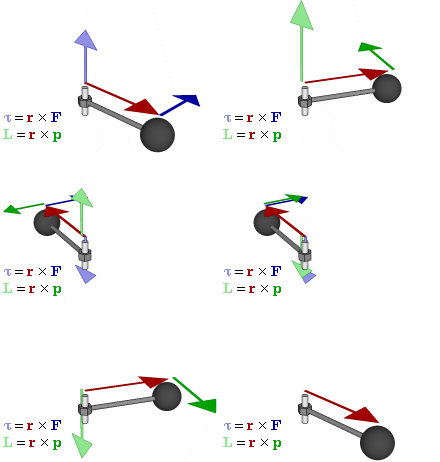
Fortunately these people are WRONG! Most any bodyweight exercise can be increased or decreased in difficulty by modifying body position and thereby adjusting the torque (<--click this link, it is worth understanding!) and effective resistance.


This can be done throughout a set so that one is continuously working at their maximum possible tension level. Bodybuilders sometimes adjust the weight during a set by taking of plates once they hit failure. This is called a drop-set. Bodyweight exercise allows even finer control though, as it is possible to increase resistance on the eccentric (also know as the negative or lowering portion) of the rep where you can handle more weight and then decrease it on the positive (concentric or lifting phase) where you are weaker. For example in the glute ham raise, one can do the negative with the arms extended overhead and the positive with the arms at the sides. It would also be possible to bend the waist a little more on the negative than on the positive. In addition to this variation one can gradually decrase torque from rep to rep. In this way one can be at the point of muscular failure for the entire set!

This technique is very hard on the body and should probably not be used for every set. Nevertheless I tend to use it all the time, because I can't get enough of the burn. For the time being I'll call these torque sets. Can you guys think of a better name, let me know in the comments. Also I'd be curious to hear if any of you employ this method and on what exercises.

Weird Pull-up Contest

Is this a Man or Woman?


Leave your guesses in the comments

Rich Simpson Bouldering

Some of you might remember Rich Simpson from our previous post on him. Well here he is in action:


(thanks to Rick for finding it)

Sunday, January 25, 2009

Old Man Strength

This 63 year old has the body of a 20 year old. It appears his knees are shot but its unbelievable how strong his arms, shoulders, chest, back and abdominals are. He must have a very strong passion to keep training. Can anyone translate?


And this 72 year old is still at it as well.

Saturday, January 24, 2009

Little Man

getting $$$$$$$


somebody get him a piggy bank

Dyno records!


Current record (but it looks like there is a n extra push of the wall though)

From the comments

Donald said...

I eat Paleo, and I do intermittent fasting. I usually eat 2 meals a day unless I want to gain some weight. Since I eat Paleo, I cut out all the grains, etc. For my carbs, I used to only eat veggies and fruit for a while, but now post-workout I eat more carb dense foods to replenish glycogen, like sweet potatoes and bananas.

And to answer your question. I don't really "diet" much anymore. I used to actively try to cut down, but I can't recover from workouts on a calorie deficit.

I just ordered some leucine, glutamine, and whey protein. I'm interested in seeing how leucine and glutamine will affect my recovery. I usually am against whey protein, but it's getting difficult to gulf down all the protein I need in 2 meals.

I'm interested in hearing your thoughts on my diet.
January 24, 2009 2:27 AM
Mad Money said...

We are living in the space age, there's no need for you to make due with paleolithic era sustenance. If you eat more fruits and grains you will have more energy, and need to eat less to feel full.

Some of my favorite carb sources are Dominoes pizza, here's my usual order (lasts approx 5 days):

Order Summary
1 Small(10") Hand Tossed Pizza, Whole: Italian Sausage, Green Peppers, Mushrooms, Extra Diced Tomatoes, Extra Cheese, Light Sauce, Ham, Extra Banana Peppers, Extra Onions, Extra Premium Chicken $5.55
1 Small(10") Hand Tossed Pizza, Whole: Green Peppers, Black Olives, Beef, Diced Tomatoes, Cheese, Light Sauce, Ham, Extra Banana Peppers, Onions, Extra Shredded Provolone Cheese, Premium Chicken $5.55
1 Small(10") Crispy Melt Pizza, Whole: Italian Sausage, Beef, Extra Cheddar Cheese, Light Sauce, Ham, Extra Banana Peppers, Onions, Extra Shredded Provolone Cheese, Extra Premium Chicken $5.55

Coupon: Three full size 10-inch Pizzas with Unlimited Toppings for $5.55 each

Subtotal: $16.65
Tax: $1.39
Delivery: $0.00
Total: $18.04


I also like fiber one honey and oat flakes,


fiber one yougurt,


frozen blueberries, mangoes, and raspberries.


For protein midday I usually go with a double quarter pounder with extra onions and pickles and add one packet of hot picante sauce.
January 24, 2009 12:05 PM

Friday, January 23, 2009

Another Bar-barians requirements attempt

Here's Nakmeezy trying the requirements:


Here are the requirements:

-40 dips
-20 pull-ups
-50 push-ups
-5 muscle-ups

All done in 10 minutes, in any order but the muscle-ups must be done LAST.

Also all reps should be full range of motion and each exercise must be completed in a single set.

Perfect Squat

This is the body position at parallel in a normal squat:

.'__
/_
./_

This is the body position at paralell of the Perfect Squat:

'
|_
..|_

In case it is not clear arms are against the sides in the perfect squat but they are extended forwards in the conventional bodyweight squat Another difference is that legs are shoulder width or wider in the conventional squat and they are together for the perfect squat).

The perfect squat is not actually possible, it would require infinite force to sustain. But as you move from the normal squat to the Perfect Squat you will be in effect applying greater and greater force. The only limiting factor is your strength.

When trying this maintain a lot of body tension and go slowly. This will allow you to find the limits of your strength without tipping over.

The principle at work here is torque and you can make similar modifications to make other exercises insanely hard. It definitely works for pull-ups, or lever or planche variations.

Thursday, January 22, 2009

Glute Ham Raise (GHR)

I think that the GHR is a very underrated exercise. Here's a video showing three variations:


Now you might be thinking that it is not a bodyweight exercise because it is on a machine and he is using weights. Well the machine is not necessary and neither are the weights. Difficulty may be increased by extending the arms from the body, or beyond that by doing single leg variations. Those without access to the machine can improvise. I could prescribe a specific settup but then you might not have the necessary implements to make that work either. So let me tell you at a conceptual level what is necessary to settup an improvised GHR:

1) something to pad the knees and shins, so the weight is distributed evenly along the lower leg as you do not want all of your weight on your knee caps.

2) a wedge that you can press the soles of your feet against and that anchors your heel or ankle from above (this can be a person sitting on your legs if nothing else is available.

Hopefully I would like to get some pictures of improvised settups that have worked well for me to give you guys some ideas. Rick suggested we buy the domain ghettoglutehamraise.com that would focus on these makeshift devices.

High Protein Diets

So how many of you guys follow typical bodybuilding nutrition? You know 5-8 meals a day 1g of protein per lb of bodyweight?

I used to and I had less muscle and quite a bit more fat. Since I switched to more moderate caloric consumption, basically following the USDA RDA (recommneded daily allowance) for calories and nutrients consumed I have dropped a lot of fat and continued to gain muscle slowly. It's also a hell of a lot easier to manage my eating. Having to eat a "clean" high protein meal every two hours is a real hassle. Am I an outlier or have you guys had similar experiences. I know Rick is basically a vegitarian and it hasn't hurt his progress at all.

Here's a second question, how do you diet, do you eat differently or just less?

When I do I just cut calories but otherwise stick to an instinctive mix of foods. For me one thing that makes sticking to a restricted calorie diet is eating a lot of fiber (I love the various Fiber One products, try the Yogurt!), keeps me full longer and ensures that I get my daily quiet reading time :)

Wednesday, January 21, 2009

The Perfect Squat

Most people think that a bodyweight squat can only be used to train strength endurance utilizing high reps. What do you guys think, can it be applied to build maximal strength?

I have some techniques that I think can turn a simple bodyweight squat or indeed any bodyweight movement into a strength movement. I want to hear your thoughts though first in the comments because I don't want to prejudice you with my theories.

Sunday, January 18, 2009

Why Strength Train?

So why do you guys train for strength, or specifically bodyweight strength? Is it for fun, do you do it to cross-train for a certain sport, or are you involved in a bodyweight strength centric-sport like gymnastics or climbing? Write me back in the comments. I'm curious what brought you guys here.

Before I was into bodyweight strength training I used to love lifting weights (still do). I love the feeling of intense exertion, the rush that comes with it, and getting pumped up a few sizes bigger than normal. The main reason I switched to bodyweight strength was to increase my body control.

I had already been a dancer for many years (mostly popping, the robot and etc.) and I realized that I was being held back by my lack of upper-body strength, flexibility, and balance. Here's a clip of me from 2006:


After a few more years of strength training I would like to extend this style to include hand-balancing elements, pulling, and complete overhead leg extensions. I don't want to be limited by my body. By training it I hope to be limited only by my imagination. Of course this is an unobtainable ideal, but it gives me direction.

I'd love to be able to move like this (AMEE, from the movie Red Planet):

Climbing Sunday

Ok here are some good videos of one arm pull-ups and campus boarding, followed by a link to an interview with one of the world's best climbers, Rich Simpson.


the last guy gets about 9 reps!


Rich Simpson

Rich Simpson in NYC interview

Saturday, January 17, 2009

Human Flag

Cool Flag variations from Guinness world record holder Dominic Lacasse

Friday, January 16, 2009

Lords of the Rings

the great ringmen of the past 50 years


Learn more about them after the jump

1. Albert Azaryan aka Azarian (Альберт Азарян)
- born 11 February 1929 in Armenia
- created his own move: front lever to iron cross
- first lord of the rings
1954 World Champion (Rome, Italy)
1958 World Champion (Moscow, Russia)
1956 Olympic Champion (Melbourne, Australia)
1960 Olympic Champion (Rome, Italy)

2. Akinori Nakayama (中山 彰規)
- born 1 March 1943 in Japan
- created his own move: back lever to iron cross
1970 World Champion (Ljubljana, Yugoslavia)
1968 Olympic Champion (Mexico City, Mexico)
1972 Olympic Champion (Munich, Germany)

3. Alexander Dityatin (Александр Дитятин)
- born 7 August 1957 in Russia
- won 8 gold medals at the 1980 Summer Olympics
1979 World Champion (Fort Worth, USA)
1981 World Champion (Moscow, Russia)
1980 Olympic Champion (Moscow, Russia)

4. Koji Gushiken (具志堅 幸司)
- born 12 November 1956 in Japan
1983 World Champion (Budapest, Hungary)
1984 Olympic Champion (Los Angeles, USA)

5. Dmitry Bilozerchev (Дмитрий Билозерчев)
- born 22 December 1966 in Russia
- in 1985 Dimitri had a car accident and almost lost his leg. Despite the critics he returned to sport and won 1988 Olympics
1983 World Champion (Budapest, Hungary)
1988 Olympic Champion (Seoul, Korea)

6. Yuri Chechi
- born 11 October 1969 in Italy
1996 Olympic Champion (Atlanta, USA)
1993 - 1997: 5x World Champion
http://www.jurychechi.it

7. Dong Zhen
- born 2 February 1977 in China
1999 World Champion (Tianjin, China)

8. Szilveszter Csollany
- born 13 April 1970 in Hungary
2000 Olympic Champion (Sydney, Australia)
2002 World Champion (Debrecen, Hungary)

9. Jordan Jovtchev (Йордан Йовчев)
- born 24 February 1973 in Bulgaria
- competed in 5 Olympic Games (2008, 2004, 2000, 1996, 1992)
2001 World Champion (Ghent, Belgium)
2003 World Champion (Anaheim, USA)
2004 True Olympic Champion (Athens, Greece)

10. Yuri van Gelder
- born 20 April 1983 in Netherlands
- Sergeant in Dutch Army
2005 World Champion (Melbourne, Australia)
2005 European Champion (Debrecen, Hungary)
http://www.yvangelder.nl

11. Chen Yibing (陈一冰)
- born 19 December 1984 in China
2006 World Champion (Aarhus, Denmark)
2007 World Champion (Stuttgart, Germany)
2008 Olympic Champion (Beijing, China)

2008 Gymnastics world cup finals Rings

I think Yuri got robbed, but Vorobyov Olexander started his routine with a realy cool kip to maltese.


Alain Robert

New clip on the man that some call the best climber of all time.

Tuesday, January 13, 2009

Bar-barians requirements

The Bar-barians issued a challenge, to become a member.

-40 dips
-20 pull-ups
-50 push-ups
-5 muscle-ups

All done in 10 minutes, in any order but the muscle-ups must be done LAST.

Also all reps should be full range of motion and each exercise must be completed in a single set. So far a bunch of you have submitted your attempts at the requirements. Here are some of the better entries I found around youtube. Big respects to all of these dudes:


If you would like me to post your attempt here leave it in the comments.

Gymnastic Bodies Seminar

Coach Sommer of Gymnastic Bodies will be hosting a seminar on May 23-24 in California. It's $500 which is expensive, but Coach really knows his stuff and is a very smart guy to boot. So if you're interested check it out

Here's a picture of the seminar location:

Bar Commision representing in Wingate

Here's some more footage from summer '08 to help get us through the winter:

Sticky and Livewire Urban freeflow

watch them take NYC by storm:


Saturday, January 10, 2009

Classic Interview

If anyone knows how to get in touch with Jasper please let me know.

Courtesy of Power Athletes Mag

A Conversation between Chinning Greats

by Brad Johnson with Jasper Benincasa

Once in a great while, a person becomes a master of his/her art. Becoming a master requires the rare combination of desire, natural ability and intelligent training. I had the opportunity to talk with a master of the art of chinning. What follows is a summary of the conversation that I had with Jasper Benincasa. This was not conducted as an interview and these were not the exact words used. However, I believe that this summary adequately portrays the conversation that we had. It was extremely rewarding for me and Jasper seemed to enjoy talking with someone who had an appreciation for bodyweight strength feats.

Brad: I got a copy of The Super Athletes about 10 years ago. I always viewed your feats with great interest because our height and weight was about the same. I understand from Jack Arnow that some of your greatest feats were not mentioned in the book.

Jasper: There is a lot of hearsay in that book. I never cared much for publicity and it is not important anyway.

Brad: What strength feat were you proudest of?

Jasper: The double bodyweight chin. At a weight of 130 pounds, I did a chin-up while holding a 265 pound man with my legs.Brad: That is incredible! I heard that you did 19 consecutive one arm chins! What were some of your other strength feats?

Jasper: I once picked up a 90 pound person with my legs and did an Iron Cross. I also held an Iron Cross with one finger on each ring. I used to do a stunt where I stood on a platform with a hangman's noose around my neck. When the platform was removed and I was falling, I would catch the rope above my head and do a one arm pull-up. I removed the noose with my free hand and then climb up the rope in front lever position.

Brad: Did you do any other rope climbing?

Jasper: Rope climbing was a sport back then. A friend asked me to climb in a competition at Penn State. I hadn't done it before and when I got to the top of the rope, I missed the black mark. I would also climb a rope with one arm.

Brad: One arm without the use of your legs?

Jasper: Of course!

Brad: That means that you would have to hop!

Jasper: That's right! It all comes down to I.M. (Initial Momentum). It is also important to have rosin on your hands for this or you will slip.

Brad: I understand that you did one arm front levers. I have been working on those for a while without much success.

Jasper: Yes. I got tired of doing them two armed. Do you have a solid two arm front lever?

Brad: Yes.

Jasper: Slowly let yourself down. Turn your body a little to the side and straddle your legs. Do you know what I mean?

Brad: Yes. I will try that!

Jasper: It will decrease the strain on your body.

Brad: Were you a gymnast?

Jasper: No. They use a lot of momentum. I liked the strength movements because they are pure.

Brad: What are your recommendations on dealing with and preventing injuries?

Jasper: I usually did my one arm chins by alternating arms and this decreased the strain on my shoulders and elbows. You will experience elbow tendonitis. The only thing you can do is rest.

Brad: How frequently did you train?

Jasper: My training was very haphazard. I'd train as often as I could. I was a construction worker and I would chin on the scaffolding after I was already tired from work. I would do alternate one arm chins down the length of the scaffolding and then turn and work my way back. My wife couldn't understand why I was tired when I got home from work!

Brad: It has been an honor talking to you! Thank you very much!

Jasper: Thank you! You got my ego flowing! Call me any time if you have any other questions.

Friday, January 9, 2009

advanced tuck planche to straddle planche

For some this is a very difficult transition to make. Here is the advanced tuck planche:


and here is the straddle planche:


(both pictures are of Jim Bathurst of Beastskills)

The straddle planche is a more difficult move primarily because it creates more torque on the shoulders. You can overcome this by strengthening the shoulders. Some small changes can be made to the adv. tuck planche to make it more challenging:

1) work the advanced tuck planche with fingers pointing back at 45 degrees / \
2) make sure that your shoulders are fully extended and elbows completely locked out
3) keep your lower back fully flat or even a little bit arched
4) start moving the legs further back torward the half-lay position

In fact the straddle planche can be bypased entirely by gradually progressing torwards the half-lay. The half lay is identical to a full planche except you may bend at the knees to reduce torque. So knees bent 180 with the heels almost touching the glutes would be easiest.

There is also the secondary challenge inherent in the staddle planche that is not a factor in the adv. tuck planche or the half lay. To avoid it you may want to bypass the straddle in favor of a gradual transition to the half-lay. The challenge is that the straddle requires hip flexibility and strength that may require seperate focus. Flexibility may be worked with simple straddle stretching but strength may be built with an exercise called youngs:

"This excellent exercise is the most specific for directly increasing your ability to open your hips fully while in a straddle planche. It is also however the most challenging and will be quite difficult to perform unless you already have a straddle L. From a straddle L, and without lifting the hips whatsoever, rotate the legs back behind you until they are together and then return back to the straddle L. During the arc of movement, attempt to very lightly brush the toes along the ground at all times. Once the legs come together, do not allow the back to arch and immediately begin reversing the arc of movement. Intense cramps throughout the hips and glutes are quite common when first beginning to train this movement."

this is from Coach Sommer on Gymnastic Bodies who also has some other suggestions

Thursday, January 8, 2009

Climbing technique

I just found an interesting video on our newest follower's blog :


It seems to me like this type of open strength could be very well trained with typewriter pullups, especially the transition from arm to arm across the top of the bar:

Parkour, Urban Freeflow

Me and Rick had a chance to meet up with the guys from Urban Freeflow while they were visiting NYC from the UK. I think Rick got some great footage. As a preview here is livewire showing his amazing strength and acrobatic ability. Look out for the wide arm hand stand (like an inverted iron cross not on the rings).


Urban Freeflow Website

EDIT: thanks to our anonymous commentator for correcting my terminology

Wednesday, January 7, 2009

The benefits of bodyweight exercise

Bodyweight exercises allow you to adjust difficulty in infinitesimally small increments by altering body position to increase or decrease torque, and they minimize the chance of injury by eliminating external load which could cause injury if out of control. They also increase coordination relative to machines or free weights with benches. This is the case because one most learn new positions to advance and access more demanding bodyweight exercises, while free weights or machines allow difficulty to be adjusted via increased external resistance.

If you think you're too strong for bodyweight exercises complete the following:

one-arm legs together push-up
one-arm pull-up
one leg glute ham raise
one leg squat (with back straight and upright, and working knee behind toe)

These are tough but if they're too easy I can prescribe way tougher.

Gymnastics and Climbing


Article by Kerwin Klein from John Gill's site

"In the early 1980s, as Jean Bonner and I were riding up the fire road to Black Mountain, the fuel line on her ’66 VW van ruptured, splashing high-octane across the overheated engine. The van stalled as the fan belt melted in the flame. I leapt out, opened the side door, and made an emergency decision: I reached into the back for my brand new, laminated, maple gymnastics rings and carried them off to safety. Then, I went back and doused the fire. I wasn’t much of a gymnast, but I had my priorities straight.

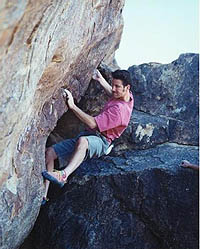
"At age 19 I had found a home in mountain climbing after years of other sports—motocross, football, a bit of recreational gymnastics. Mountain climbing led me to the local boulders, at Larrabee Beach State Park, and bouldering brought me back to gymnastics. There were no climbing gyms, so during the wet winters of the Pacific Northwest, gymnastics offered a way to stay in shape. Beside, I had read an obscure book, Master of Rock, about a guy named John Gill who had mixed gymnastics with climbing. I specialized in the rings, although I also climbed rope, initially as a complement to climbing. Soon after moving to Southern California in 1981, I bought my rings and began coaching men and women’s gymnastics at the YMCA in San Jacinto. Later, I moved on to the Riverside Y where I coached the Men’s Team for another five years or so. I never really competed, and my ring work could be charitably described as mediocre, but I could do giants and kips, had a creditable front lever and cross pullout, and a half-assed inverted cross. My best trick was my V-sit that I could lower down into a ¾ cross and then pull out. I loved ringwork almost as much as the mountains, but I was especially intrigued by the idea of blending gymnastics and climbing.

Although I did a lot of roped climbing, I came to prefer hard bouldering and long, easy solos to messing with gear. In those days there were few bouldering specialists on the West Coast, although many of the top climbers, notably John Long and John Bachar, took bouldering very seriously. I was deeply impressed by Bachar, but Long was more nearly a model, as famous for his beefcake coverspreads for Climbing magazine as for his bouldering. Neither I nor anyone else was going to replicate Largo’s corn-fed physique on a diet of rock climbing. I had a terrific time trying to keep muscle on—rings, weights, and protein shakes would add muscle, then hours of hiking and climbing would burn it off. So I’d train more, get into good shape, and then snap a tendon and go back to hiking for two or three months and come back skinny again. I spent more time rehabbing than climbing for many of those years—and coaching didn’t help, with my inflamed rotator cuffs sometimes the only thing standing between an out-of-control gymnast and a hard landing. Climbers today may find it hard to believe, but I was constantly working to add weight.

In the 1980s the bodybuilding aesthetic went mainstream—the waxed pecs of Sylvester Stallone and Arnold Schwarzenegger replaced Sean Connery’s hairy but considerably less robust chest as markers of ideal manhood. And since I had grown up in Southern Illinois, where the ability to eat, drink, and get big enough to toss hogs were standard measures of masculinity, I had special body issues. At one point, I think it was the summer of 1990, when I was at my beefiest, at least as a climber, I went back home to Southern Illinois for a visit. I weighed about 190, without much body fat. My relatives were horrified—they thought I was emaciated, and they fretted over my health. They stuffed me with pie and pork chops, and by the time I hit the road west, I was over two hundred pounds (they still thought I was too skinny). Needless to say, the next week was not one of my more triumphal bouldering tours. But as in Gill’s case, part of my love for training grew out of cultural notions about what constituted the ideal male body as much as interest in improving my climbing.

Not surprisingly, I developed a taste for the few routes that rewarded all those hours on the rings, and on Southern California granite, in the 1980s, that meant mantles with an occasional juggy roof or crack thrown in. By 1984 I had built up a circuit of B2 mantles at Black Mountain and Joshua Tree, but the next five years were devoted to work, school and a seemingly endless cycle of injuries. Gymnastics and bouldering didn’t really come together for me until I spent a year in Arizona. Once there, I realized that my bouldering had stagnated badly.

In 1989 I landed in Tucson for a year of graduate school and quickly smacked into Bob Murray’s legacy. Murray had left a slew of inconceivably hard routes in the surrounding desert. I spent several months bouldering with some of his old partners, John Gault and George Smith, usually watching as they hung, upside down and barefoot, on underfed holds that looked more suited to slab climbing. They told me terrifying Murray stories: dropping thirty pounds to maximize his crimp strength; slicing a snickers into tiny bites to place on the exit holds of one of his projects as a motivator; his bouldering partner, Frank Abell, damaging his heart with climbing-related dieting. I have no idea how many of the stories were true, but the routes were fascinating—sit-down traverses across low, roofy chunks of rhyolite, in bare feet because the underslung footholds were too small to accept period climbing shoes. John and George also had a visually distinct style that apparently descended from Murray: they never hooked their heels; they avoided matching hands in favor of crosses; and their traverse sequences frequently placed the weak hand on the worst hold of the route. Although I had bouldered eliminates before, and Gill and others had practiced them for decades, I had never seen elimination done so systematically. Each and every rhyolite ripple had been stroked into some sequence—we could spend hours on a crummy little butt nugget less than forty square feet without ever repeating a route. Before the rise of climbing gyms, that sort of focus was unusual.

I never truly developed a taste for power crimping, but I did start working a lot more on my finger strength, and after I returned to Southern California, began integrating gymnastics and bouldering more seriously. I kept up some of my rings skills and thought more analytically about ways to translate those motions to the rock.

I could think of at least three models for mixing gymnastics and boulders. The most developed was that of Gill himself, which I knew largely through print, images, and stories from mutual friends. Master of Rock presented a gymnastic ideal in black-and-white stills. I spent hours studying all those carefully selected photos of a Gill, his face blank, outfitted in sports shirts and kletterschuhe, his body artfully arranged in straight, clean lines. John Bachar’s polished soloing and bouldering routines offered a second model. I didn’t know John well, but I wasn’t the only newbie who had been schooled in his mix of smoothness and theatricality. Finally, I had the Tucson lessons on elimination. And of course, one could always try to apply gymnastics rules to bouldering.

Gymnasts were expected to mix easy, intermediate, and difficult parts (in those days, A, B, and C moves) into an aesthetically pleasing routine that also demonstrated risk, originality, and virtuosity. But standards of beautiful movement changed with time and taste. For instance, most of the older gymnasts I knew had been coaching to do handstands with their backs slightly arched, for ease of balance. But my training had emphasized a purely vertical line. On the rings, too, things had changed. By the 1980s, the rings performer never bent his elbows, which meant than an entire genre of older moves, some of them quite difficult, had disappeared from the canon. In bouldering, the situation was even more elastic. Gill had suggested that a genuinely gymnastic boulder should overhang and probably involve dynamic movement, but beyond those injunctions, things seemed wide open.

I could see two different ways to approach the very idea of gymnastic or power bouldering, or rather two different basic ways of making a problem difficult purely by virtue of its demands on muscular strength. One way was to make a route difficult by arranging it so as to minimize the size and quantity of muscle that could be employed. The best example would be a radical overhang climbed with only one arm on a bad hold. Such a route basically reduced most of the body to dead weight and placed all the stress upon a small cluster of muscles—to make the route harder, one would select increasingly bad hand holds, reducing even further the number of muscles that could help with the work. There was a clear law of diminishing returns in such an approach. Campusing and dynamic pulling through overhangs, while minimizing reliance upon the feet, had been one of the hallmarks of many of Gill’s most classic performance routes. But it was becoming clear that weight, rather than upper-body strength, would prove the limiting factor for such routes. Campusing would tend toward the production of the skinniest possible climbers.

A second way of designing a powerful problem was to go in something like the opposite direction and arrange it so that it demanded the maximum utilization of the largest, core muscle groups. But such routes were rare. A few types of bridging routes, and certain types of mantles and gastons, made those demands on the big muscle groups, but these were not especially popular or even available. And by the early nineties, the cutting edge in bouldering had gone in the other direction. Cracks and mantles were completely out of fashion. The new classic problems looked much like the woodies then springing up in garages and basements: overhung faces with easy top-outs, minimal feet and increasingly tiny crimps for campusing. I did a lot of those routes, but I never fell in love with them. They just hurt too much.

Instead, I changed the ways that I looked for routes. Where before I had looked for attractive lines and then worked out the moves I needed to climb them, I now visualized moves that I wanted to do and then looked for rocks that would allow me to perform them. I didn’t particularly care if they had a summit or a clear beginning and end. The ideal was a route that approximated the basic requirements of a gymnastics routine. I wanted a route short enough to be performed in something like a single, continuous flow of motion without stopping to chalk, rest, or analyze the coming moves; that demanded a great deal of core power; and that also required or facilitated at least a display of flexibility and delicate footwork. Usually, these routes featured what the current jargon calls “shoulder moves” or “body tension” moves. A few were independent lines with summits. A few were well-known routes. Bachar’s Caveman at Joshua Tree was an example, especially if done backwards (left to right), the old-school way (until the very tiny exit foothold, which had made it more than just a strength display, crumbled underfoot in the mid-nineties and left it a pure thugfest). But the harder routes were contrivances. Many had no real summit and bore little resemblance even to a conventional eliminate. Needless to say, by this point, I was bouldering alone quite a bit.

My best, and not coincidentally, healthiest seasons came in the early nineties at Malibu Creek, Black Mountain, Joshua Tree, and Priest’s Draw. I was in my early thirties, too old for competitive gymnastics, and working sixty plus hours a week in grad school, but I had retired from coaching and my rotator cuffs appreciated the rest. After visiting Priest’s Draw with John Gault in 1989, I returned several times, including a month-long trip in the fall of 1993. Priest’s Draw was an ideal spot—nice fat-radius pockets, slopey pinches, and bear-hugs out limestone roofs. Many of the roofs were too low for campusing or swinging, but I found them delightful because their position made for many happy hours in a front or side lever position. In those days, almost no one bouldered seriously at the Draw (Robert – had been killed a short time before), and in addition to my usual contrivances I also got to develop a lot of independent lines like Carnivore and Kleinian Spindle. And back in California, Scott Erler and I spent a lot of time at Black Mountain scoping out and developing new areas like the Cube, the NRAs, and the Visor that offered traditional lines along with eliminates.

My favorite Black Mountain route, True NRA, was aggressively contrived. The regular NRA was a short 130-degree problem whose easiest resolution involved a dyno from a sloper and a pinch to an incut summit. The more difficult way to do it was static, with a twist-lock to the summit. One could also do it as a sit down, with a quick dyno through a set of slopers. True NRA followed the same line of holds, but was very different. It was a static, no-swing, no-dynamic routine that began sitting down and then moved upward through two very difficult gastons to the twistlock exit. It was a weird route, and not the sort of thing that anyone was likely to hear of much less care about repeating. I mention it here because it pointed up the changing fashions of even gymnastic approaches to bouldering. Where thirty years earlier, Gill had deliberately minimized foot placement and seen dynamic movement as the essence of a gymnastic approach, True NRA went the other direction: eliminating swinging and dynamics in order to create a more “gymnastic” sequence.

I don’t want to make this scrawny footnote to American bouldering history sound beefier than it was. One of the reasons I thought so much about these issues was that I had plenty of downtime recuperating from injuries. Part of becoming a great athlete is having the combination of good habits, good genes, and good luck to avoid serious recurring injuries. That didn’t happen to me. And most of the American boulderers of the 1970s and 1980s, the generation between John Gill and Chris Sharma, were basically placeholders, consolidating and popularizing the things Gill had done in the fifties and sixties. Many of these folks were marvelously talented, but arguably, only Jim Holloway and Bob Murray substantially changed the sport or elevated difficulty levels in a serious way, and neither of them had anything like Gill’s profile or impact on the larger climbing universe. Bouldering in the U.S. in the 1990s changed partly under the impact of visitors from England and Europe—the dramatic success of Jerry Moffatt convinced many sport climbers that bouldering had instrumental value for roped climbing--but mostly because of climbing gyms. The new artificial walls provided sport-specific training that was far more efficient than rings or doorjamb pull-ups and far less likely to pack on all those great slabs of delt and pec that had provided a campy Muscle and Fitness flavor to Largo’s photo sessions.

I still have my rings but seldom touch them. The long easy solos are still part of my routine, but the hard bouldering has faded away. A couple decades of rocks and rings have left me with much more scar tissue and many fewer muscles than I once had. Years of jumping off boulders have hammered my back. These days, “drugs” mean Celebrex, a shoulder move involves reaching for a beer, and body tension is what I get at work. And I’m still waiting for the twenty-first century integration of gymnastics and boulders"