Showing posts with label torque. Show all posts

Friday, August 21, 2009

Slow Muscle-ups -> Close to impossible

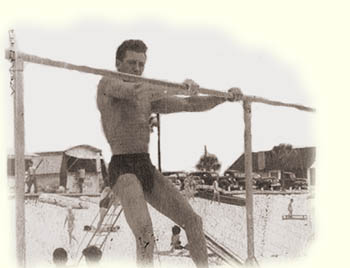
Here is a photo of legendary bodyweight strength specialist Jasper Benincasa performing what is called the Close To Impossible (CTI for short):


Supposedly this photo was not taken midswing or with Jasper standing on a block, it is a STATIC hold! Now let's put aside for a second whether or not this is true, instead lets take it as a goal (even if it is possibly unattainable). We can try to progress from a slow muscle-up on the bar torwards the CTI first by performing a slow bar muscle-up with a wider and wider grip until we are doing it with the arms almost straight and then once this becomes easy if ever we can start doing it with the arms straight and a narrower grip. Or we can try to progress from a victorian on the bar torwards this goal by gradually lowering the body whilst maintaining distance from the bar.

These progressions are too advanced to be attempted by most anyone I know anytime soon but they illustrate in a general sense another way that torque can be used to make any bodyweight exercise almost impossiblly difficult. For more on torque and bodyweight sttrength check these past posts: Generally, with regard to pistols

Friday, January 30, 2009

More on Torque, pistols

To make Pistols harder try holding the arms at the sides as demonstrated here by pistol master Steve Cotter:


rather than in front of the body as seen demonstrated here by Jim of Beastskills:


Another option is to do the pistol on a box or a ledge and let the non working leg hang down over the edge rather than straight forward.

Either of these variations makes the movement more challenging by reducing counterbalance and increasing the torque acting on the working joints.

Tuesday, January 27, 2009

Advantages of Bodyweight Training, Torque Sets!

We have talked previously about the benefits of bodyweight training and I'd like to discuss another one of the less appreciated advantages of this form of exercise.

Most people who don't know very much about bodyweight work think that it is limiting in that you can't control how much resistance you are utilizing. At a first pass this would seem to be true, after all you can't change what you weigh right? Well maybe you can over the long-term, but certainly not between sets. This leaves people thinking that bodyweight work would not be appropriate for them because they are either too heavy or too light to get a goo work-out with bodyweight given their strength level.

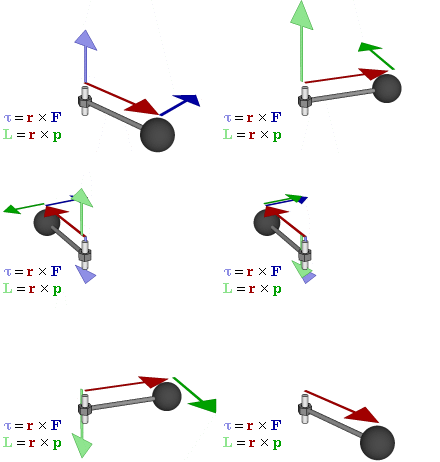
Fortunately these people are WRONG! Most any bodyweight exercise can be increased or decreased in difficulty by modifying body position and thereby adjusting the torque (<--click this link, it is worth understanding!) and effective resistance.


This can be done throughout a set so that one is continuously working at their maximum possible tension level. Bodybuilders sometimes adjust the weight during a set by taking of plates once they hit failure. This is called a drop-set. Bodyweight exercise allows even finer control though, as it is possible to increase resistance on the eccentric (also know as the negative or lowering portion) of the rep where you can handle more weight and then decrease it on the positive (concentric or lifting phase) where you are weaker. For example in the glute ham raise, one can do the negative with the arms extended overhead and the positive with the arms at the sides. It would also be possible to bend the waist a little more on the negative than on the positive. In addition to this variation one can gradually decrase torque from rep to rep. In this way one can be at the point of muscular failure for the entire set!

This technique is very hard on the body and should probably not be used for every set. Nevertheless I tend to use it all the time, because I can't get enough of the burn. For the time being I'll call these torque sets. Can you guys think of a better name, let me know in the comments. Also I'd be curious to hear if any of you employ this method and on what exercises.
Friday, January 23, 2009

Perfect Squat

This is the body position at parallel in a normal squat:

.'__
/_
./_

This is the body position at paralell of the Perfect Squat:

'
|_
..|_

In case it is not clear arms are against the sides in the perfect squat but they are extended forwards in the conventional bodyweight squat Another difference is that legs are shoulder width or wider in the conventional squat and they are together for the perfect squat).

The perfect squat is not actually possible, it would require infinite force to sustain. But as you move from the normal squat to the Perfect Squat you will be in effect applying greater and greater force. The only limiting factor is your strength.

When trying this maintain a lot of body tension and go slowly. This will allow you to find the limits of your strength without tipping over.

The principle at work here is torque and you can make similar modifications to make other exercises insanely hard. It definitely works for pull-ups, or lever or planche variations.

Wednesday, January 21, 2009

The Perfect Squat

Most people think that a bodyweight squat can only be used to train strength endurance utilizing high reps. What do you guys think, can it be applied to build maximal strength?

I have some techniques that I think can turn a simple bodyweight squat or indeed any bodyweight movement into a strength movement. I want to hear your thoughts though first in the comments because I don't want to prejudice you with my theories.